Sports Labs

Frequently Asked Questions

Get answers to your most common questions here on our FAQ page. Don’t see your answer? Contact us to get more information.

General & About Sports Labs

Who is Sports Labs and what do you do?

Sports Labs is an international leader in the testing, technology, and consultancy of sports surfaces and infrastructure. We provide independent, scientific verification for natural grass, synthetic turf, and hard-court systems to ensure they meet the rigorous safety and performance standards set by global governing bodies.
Our headquarters are in Livingston, Scotland, but we operate a global network with offices and laboratories in the United Kingdom, United States, Canada, Italy, France, Norway, Sweden, the Netherlands, China, Turkey, South Africa and Israel.
We provide technical services for every level of sport, from local primary schools and community clubs to professional stadiums hosting Olympic, FIFA World Cup, and World Rugby events.

Laboratory Testing (Material Science)

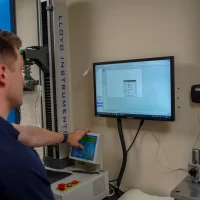
Laboratory testing evaluates the raw materials and components of a sports system (such as turf yarn, shock pads, and infill) before they are installed. This ensures the products are durable, non-toxic, and capable of meeting performance benchmarks in a controlled environment.

ISO 17025 is the international standard for the competence of testing and calibration laboratories. Sports Labs holds this accreditation, which means our results are technically valid, impartial, and globally recognised by federations like FIFA and World Athletics.
The LISPORT test is a mechanical wear simulator used in our laboratory. It subjects synthetic turf samples to thousands of cycles of studded rollers to predict how the yarn will flatten and degrade over years of actual use.
Yes. We perform Particle Size Distribution (PSD) and hydraulic conductivity testing on rootzones, drainage sands, and gravels to ensure they provide the optimal balance of stability and drainage for natural turf pitches.

Consultancy & Design

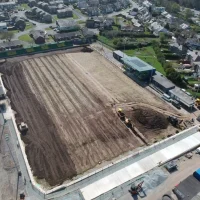
A consultant provides independent technical expertise through every phase of a project, from initial feasibility studies and site assessments to developing tender specifications and monitoring the construction process.

If a field is failing (e.g., poor drainage or surface irregularities), a diagnostic survey identifies the root cause through core sampling and technical audits. This allows for targeted remediation instead of a total, expensive resurfacing.
Yes. We act as independent technical advisors, drafting performance-based specifications and evaluating contractor bids to ensure the client receives the highest quality facility for their budget.

Site & Field Testing (On-Site Verification)

Laboratory testing establishes the theoretical performance of a product, while Site Testing (Field Testing) audits the “as-built” facility. Site testing verifies that the installation performs correctly under real-world conditions. This includes the sub-base and drainage

G-Max testing measures the shock-attenuation (hardness) of a sports surface. It determines how much impact force is absorbed by the field versus the athlete. Maintaining safe G-Max levels is critical for preventing concussions and lower-limb injuries.

HIC testing assesses the risk of traumatic head injury on a surface. It is used to determine the “Critical Fall Height,” ensuring that surfaces in playgrounds or high-impact sports areas are soft enough to prevent life-threatening injuries during a fall.

For facilities hosting sanctioned match play, most governing bodies (FIFA, World Rugby, FIH) require a professional re-test every two years to ensure ongoing safety and performance compliance.

Key Stage Inspections are independent audits performed at critical points during construction (e.g., sub-base compaction). These inspections identify engineering errors before the final surface is laid, protecting the facility’s 10-15 year lifespan.

Technology & Innovation

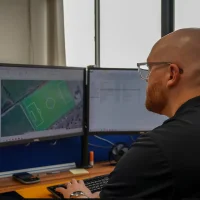
ProPitch is a digital testing platform and toolset developed by Sports Labs to standardise the assessment of natural and hybrid grass. It allows grounds managers to track pitch health, ball roll, and traction metrics in real-time.

The Triple A is a precision instrument that simulates the impact of a human athlete on a surface. It measures force reduction and vertical deformation to ensure the pitch offers the correct biomechanical support.
Yes. Our Innovation department focuses on the “Circular Economy,” testing recyclable turf yarns, biodegradable infills, and energy-efficient lighting solutions to reduce the environmental footprint of sports infrastructure.

Lighting & Infrastructure

Lux measures the amount of light, but uniformity (U1/U2) measures how evenly it is spread. High uniformity is essential for player safety and high-definition sports broadcasting, as it eliminates “dark zones” on the field.

It is a third-party verification of a floodlighting system using calibrated meters. Sports Labs provides these audits to ensure that a new or retrofitted LED system meets EN 12193 standards and does not cause light spill into neighbouring areas.

Specific Sports Standards

This is a technical governance framework for squash court components. Sports Labs authored the foundational “Specification and Test Methods for Squash Flooring,” which is now the global benchmark for Olympic and PSA Squash Tour facilities.

3G pitches must comply with the FIFA Quality Programme for Football Turf, which sets two standards: FIFA Quality (for community and development use) and FIFA Quality Pro (for professional and international play).

World Rugby requires surfaces to meet the Regulation 22 standard, which focuses heavily on shock absorption and skin-surface friction to ensure the pitch is safe for the high-impact nature of rugby.

Asset Management & Maintenance

Developed by Sports Labs, the Free Pile Ratio is a KPI used to monitor yarn health and infill levels. A ratio below 0.75 typically signals that the yarn is flattening and ball roll speeds are becoming unacceptably high.

Most manufacturers require a log of professional maintenance and periodic independent testing (like those provided by Sports Labs) to honor a warranty. Our reports provide the “Technical Baseline” needed to validate performance claims.

Accreditations & Legitimacy

Yes. Sports Labs is a strictly independent, third-party test house. We do not manufacture or install sports surfaces, nor do we have financial stakes in construction companies. This independence ensures that our test reports and consultancy advice are completely impartial and focused solely on technical compliance and athlete safety.
ISO/IEC 17025 is the gold standard for laboratory competence. Unlike a standard business certification, this accreditation proves that our laboratory has been independently audited for its technical ability to produce precise and accurate test results. It is the mandatory requirement for results to be accepted by FIFA, World Rugby, and other international federations.

Sports Labs holds official laboratory and field-testing accreditations from the world’s leading sports authorities, including:

  • FIFA (Football Turf, Footballs, Goal-Line Technology, and Floodlights)
  • World Rugby (Regulation 22)
  • FIH (International Hockey Federation)
  • World Athletics (Track and Field)
  • ITF (International Tennis Federation)
  • FIBA (International Basketball Federation)
  • World Squash (Quality Programme)

Yes. Because our results are produced under the ISO/IEC 17025 framework and accredited by international federations, a Sports Labs test report carries the same weight and validity in London and New York as it does in Tokyo or Johannesburg.

Yes, we are active members and contributors to several leading industry bodies, including:

  • SAPCA (Sports and Play Construction Association)
  • ASBA (American Sports Builders Association)
  • ISSS (International Association for Sports Surface Science)
  • ESTC (European Synthetic Turf Council)

Industry Leadership & Partnerships

Yes. We don’t just test to existing standards; we actively contribute to their development. For example, Sports Labs authored the “Specification and Test Methods for Squash Flooring” for World Squash. We regularly sit on technical committees for CEN (European Committee for Standardization) and ASTM International to ensure testing protocols evolve alongside product innovation.
Sports Labs works as the technical partner for the PSA Squash Tour through the World Squash Quality Programme. We ensure that the surfaces used on the professional tour—especially the iconic glass show courts—meet the rigorous technical standards required for elite performance and global broadcast.
Insurance companies and legal teams often require independent verification from a body like Sports Labs to mitigate risk. A certified report proves that the facility was designed and built to recognized safety standards, providing a “Technical Audit Trail” in the event of an injury claim or product failure.
Yes. Due to our accredited status and long-standing industry reputation, our senior consultants are frequently called upon to provide expert witness testimony and forensic technical analysis in legal cases involving sports surface failure or construction disputes.
All Sports Labs offices and satellite technicians operate under a unified Quality Management System (QMS). Regular cross-laboratory “round-robin” testing and internal audits ensure that our testing methodology remains consistent and accurate, regardless of which global office is conducting the work.

Sports Labs Newsletter

Read Field notes & be in the Know

Subscribe to Be the first to Get the latest industry news & Updates ​

Let’s get you tested & Certified

Work with a Team of leading experts that are always ahead of the Game.